

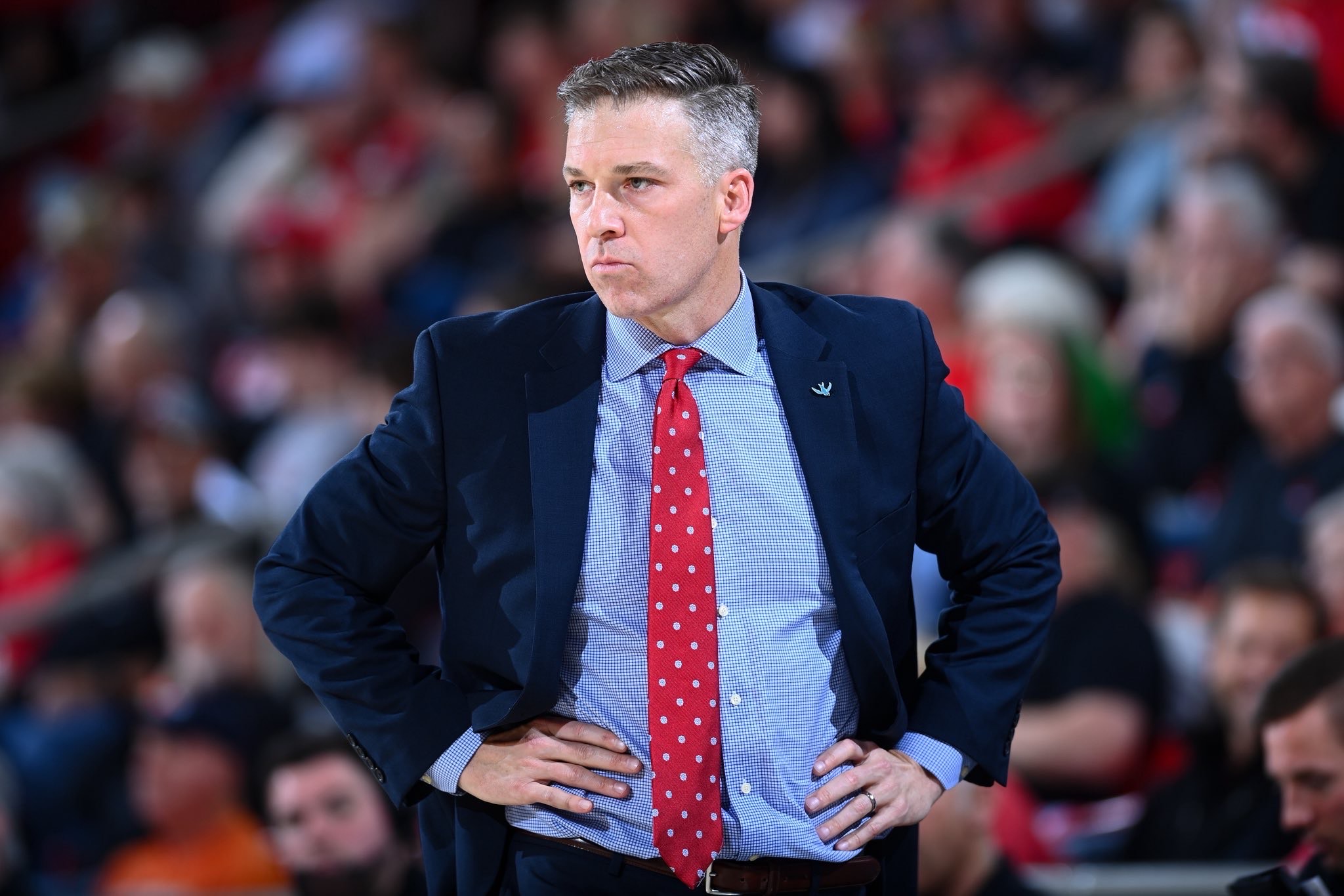
Davidson’s trip to Phog Allen Fieldhouse marked a natural transition point in the season.
The Wildcats closed non-conference play at 8-4 following a 90-61 loss to Kansas, with Atlantic 10 play set to begin December 30 against Duquesne. Kansas was never a referendum on Davidson’s season. It served as the final non-league game before conference play begins and the focus shifts fully to the A-10 grind.
I sat down with Head Coach Matt McKillop just before Davidson’s win over Mercyhurst, a game that featured the Wildcats’ most complete first half of the season. Since that conversation, Davidson followed that performance with a flat opening half at Temple and then closed non-conference play at Kansas, reinforcing that consistency remains the goal as conference play approaches.
McKillop did not separate preparation from results when we talked.
“I think it is preparing us very well for A-10 play,” he said of the non-conference schedule. “We go through our preseason, we think we’re getting better and then we realize those first three weeks are going to be a bear.”
The Wildcats responded well to that opening stretch, starting 5-0 with wins over Washington State, Charlotte, Bowling Green, and Boston College.
From McKillop’s perspective, the non-conference schedule offered an early look at what league play will demand.
“Utah State’s defense is very unique and difficult to prepare for,” McKillop said. “We were not clearly good enough defensively.”
Saint Mary’s presented a different challenge.
“Saint Mary’s is a top 20 defense,” he said. “We didn’t have a great first half, but we had a really strong second half.”
What tied those games together, in McKillop’s view, was familiarity.
“That Utah State team had four starters who played together last year. Saint Mary’s had five,” he said. “You can’t do a drill or drink a protein shake that gives you a year of experience together.”
That reality has shown up throughout Davidson’s rotation. The Wildcats have started two freshmen in Ian Platteeuw and Devin Brown and have played a number of newcomers meaningful minutes. That experience is being built in real time.
“Every time we take the court, every time we step in the film room or weight room,” McKillop said, “that’s a chance to build what we don’t yet have together.”
One theme McKillop returned to throughout the conversation was depth and balance.
“What we’re trying to instill is a mentality of strength in numbers,” he said.
That approach has been evident in how Davidson has used its rotation, with minutes and production spread evenly and contributions coming from well beyond the starting group.
“There are nights when Roberts Blums can’t come off the floor because of his defense,” McKillop said. “There are nights when JQ Roberts’ athleticism and physicality changes the game. And there are nights when Nick Coval has a matchup that allows him to be really effective offensively.”
The challenge, as McKillop acknowledged, is sustaining that identity.
“Strength in numbers has to be consistent,” he said. “It feels great in wins. It’s tougher in losses, but it’s a day-to-day process.”
McKillop framed the next step as continued growth within what the team is already doing.
“I don’t think we have to reinvent anything,” he said. “We just have to get better at these things.”
Offensively, the margins have been clear.
“Our offense has been pretty good, outside of turnovers and offensive rebounding,” McKillop said. “When we execute, our efficiency is pretty high.”
He pointed to execution in specific moments as a sign of what the team is capable of.
“On Synergy, we were 96th percentile on baseline out-of-bounds offense,” he said. “Our ability to execute there has been really good.”
“The next step,” he added, “is valuing the basketball and finding ways to get more second chances.”
Davidson’s depth has been tested most in the frontcourt. Sean Logan returned to action at Kansas, seeing his first minutes since the Utah State game following a knee injury that also cost him most of last season. Platteeuw missed time earlier in the year with mono, while JQ Roberts and Joe Hurlburt have both worked back from concussions.
That context has shaped the rotation and accelerated the learning curve across the roster. It has also reinforced why Davidson has leaned so heavily on depth.
Kansas represented Davidson’s most demanding non-conference environment, but the timing mattered as much as the opponent.
“We’re going to see an interesting road environment when we go to Phog Allen Fieldhouse, and I think that’s going to be valuable,” McKillop said.
He emphasized that what surrounds the game is just as important as the game itself.
“Getting in a hotel, doing walkthroughs in a ballroom, having a mentality we don’t have at home,” he said. “That’s how you build experience to play on the road.”
For Davidson alumni, the setting carries weight on its own.
“Phog Allen Fieldhouse is historic,” McKillop said. “It’s not just the coach or the players. It’s the history.”
With non-conference play now complete, what follows will matter more. Davidson finished 6-12 in Atlantic 10 play last season with a very different roster, and this year’s group enters league play deeper, with less shared experience, and still sorting through what it can be.
“I think we’re still just scratching the surface of the team we can be,” McKillop said.
One chapter closed in Lawrence. The next begins December 30 at Exit 30, with No. 30 in the building.
Conference play will bring the answers Davidson is looking for.
Q&A with Head Coach Matt McKillop
On how the non-conference schedule has prepared the team for A-10 play
“I think it is preparing us very well for A-10 play. You go into building a schedule with a blueprint, but it never goes exactly as planned. All of a sudden you’re starting the season with Washington State, on the road at Charlotte, Bowling Green, and then the Charleston Classic. We realized pretty quickly those first three weeks were going to be a bear.
“For us to be as ready as we were with so many newcomers, to compete at a high level and execute at a high level, not that we did it as consistently as we need to, I’m really pleased with that. We played against the level we’re going to see night in and night out once conference play starts.”
On road environments and why they matter
“Charlotte was the only true road environment we played in, but it’s really the experience around the game that matters. Getting in a hotel, going through a walkthrough in a ballroom or meeting room, having that mentality that we don’t get when we’re in Belk Arena or our own practice gym.
“That’s where our guys have to develop experience to be prepared to play on the road. We’re going to see an interesting road environment when we go to Phog Allen Fieldhouse and I think that’s going to be valuable.”
On building experience with a new group
“Every single time we take the court, every time we step in the film room or the weight room, that’s a chance to build what we don’t yet have together. That experience doesn’t exist without us being present and mindful of it.
“I think we’re still scratching the surface of the team we can be.”
On depth and lineup flexibility
“What we’re trying to instill is a mentality of strength in numbers. There are nights when Roberts Blums can’t come off the floor because of his defense. There are days when JQ Roberts’ athleticism and physicality can change the game on the defensive end and on the offensive rebounding end.
“There are also days when Nick Coval has a matchup that allows him to be really effective offensively. Our guys have shown a willingness to sacrifice and be great teammates. It might be Hunter’s night. It might be Josh’s night. That has to be consistent.”
On what excites him about Kansas
“Phog Allen Fieldhouse is what I think of. It’s historic. It’s not just the coach or the players. It’s the history.
“When we had the opportunity to schedule the game, our players were excited. It wasn’t about any one player or coach. It was about going up against a perennial powerhouse in an historic arena.”
